










/* Post photos ----------------------------------------------- */ img.post-photo { border:1px solid #A2907D; padding:4px; }


The Adventures of two Fibre Artists.


Contributing Artists
Melangell
EM

Wednesday, September 06, 2006

Materials...$22.00,
Time....3 hours,
Effort....Priceless
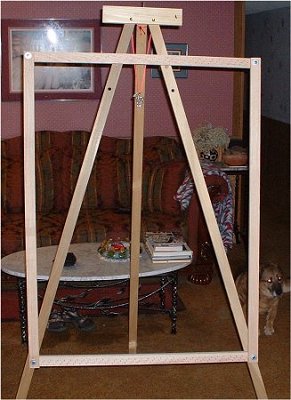
Over the years my DH has built little projects for me, and not so little projects like the screen porch and garden pond, which I have always considered to be priceless, certainly more meaningful than anything store bought. The latest gift, as I mentioned here in an previous entry, is a tapestry loom.

We went to Lowes and picked out some straight 2"X1" oak, I would have chosen the Douglas Fir, save that they did not have enough to accommodate my needs. We discussed several ways to make a sturdy frame and after some thought I asked him what he thought about bolting the sides onto the top and bottom beams so if I choose to work on a flat surface the sides will be raised enough and offer room to work my hand under the warp. He felt he could find a way of doing this and make it stable. We decided bolting the frame would offer more stability than nailing it. The next question would be what is the best way to bolt it. Instead of drilling through the top and bottom and using wing nuts on the back of the bolts DH suggested using Tee nuts that recess into the wood about halfway and sits flush with the top surface which accepts the bolt, securing it, without any hardware on the backside of the beams. This will prevent any metal possibly damaging the surface the frame will lie against. Finally when planning placement for the warp nails we drilled the holes first, staggering them to prevent the wood from splitting, before hammering the bard nails into place.

So you see the project is easy enough and very inexpensive. The materials came to $22.00, and after I return some of the hardware we ended up not needing it will actually come closer to $20.OO. While it is a basic loom, it is fully functional and saved us about $100.00 or more had we bought one of similar size. I was also happy to find that the frame DH built with the Triangle loom he gave me a couple of Christmas' ago works very well with this one also. You can see how this is the ideal way to go for anyone interested in Tapestry weaving, but not quite sure to what degree. There was very little time and expense put into the project, that if I find that I don't have the talent for this fibre craft I have not invested a great deal.

A final note, when proofreading I notice that throughout this article I have used "I" and "we" in reference to planning and building the loom when in point of fact it was my DH who contributed the most to this this project, for which I owe him a big "Thank you!"

Labels: ,

Saturday, September 02, 2006

Another Adventure

Last night my husband and I celebrated our 28th wedding anniversary. Twenty-eight years of marriage is an adventure in itself but this is not the adventure I mean to discuss here. I only mention it as a lead in, of sorts, because after dinner he took me to Lowes to purchase supplies for a new fibre adventure. Now keep in mind I barely have time for the myriad of fibre adventures I already participate in. In point of fact I have resisted taking this particular adventure for some time, but the temptation has proved too alluring and my resolve all but exhausted. Whenever I mentioned to my fibre sister that I was considering embarking on this path she would offer a grin, in lieu of spoken words, that communicated sincere empathy, that another adventure would indeed be exciting, but how in the world would I manage getting anything finished. I suspect most fibre artists can relate. Whether you want to experience every aspect of the craft, or it's a matter of one thing leading to another, suddenly you find yourself overwhelmed by the possibilities.

I started out wanting to learn to spin and decided it would be great fun, since I love animals, to raise a small spinner's herd. After spinning several skeins it occurred to me, as beautiful the yarn was, some projects may require a colour other than what the animals were capable of producing. Subsequently the next logical step was to learn to dye, and with everything I do in my life I wanted to do this as natural as possible. Resultantly my fibre sister and I began researching and experimenting with natural dyes.

I want to say that our decision to learn felting came about, as with most fibre enthusiasts, by mistake, but maybe I should speak for myself. It takes little effort to discover felt when working with wool, water and soap. Then one year while at SAFF, almost as an afterthought, certainly out of curiosity, we decided to take a workshop on a different kind of felting, done with needles. So you begin to see how one can get caught up in all aspects of this multifarious craft.

The decision to embark on this new adventure was bourne from the difficulty of trying to demonstrate weaving outside the home, due to the size of our 4 harness floor looms. My fibre The triangle looms, though not as heavy, were twice as cumbersome due to their size. Until recently I had a van large enough and a husband willing to do the heavy work of getting us and the equipment to our destination and back, even the triangle looms, but with some real complications. I have since had to retire that old van and due to the rising gas prices replaced it with something smaller. This gave weight, no pun intended, to either no longer offer weaving demonstrations outside our homes or explore an alternative form of weaving, one that could be done on a smaller loom and something more sophisticated than weaving potholders like the ones everyone remembers making in school.

Tapestries have always held a real fascination for me. If done well they seemed to have a life of their own, as individual as the piece and technique. Some so moving you could hear the life within softly whispering. I can only hope that I can induce the same in my work.

When I came home from Saturday Tea this afternoon my dear husband had the frame finished. Now all that needs done is to mark the spacing for him to drill where I will place each nail for the warp. I would have some difficulty petitioning his help in hammering the nails as the memory, or should I say nightmare, of tapping nearly 400 bard nails in a Triangle loom he made me one Christmas some years ago is still too raw in his mind. Since we, like many, find ourselves on a strict budget, I am very grateful for my husband's ability and willingness to build this loom for me. The materials came to just under $22.00, which is 10 times cheaper than the more affordable, and smaller looms. Even though I could manage, with difficulty, I would be hard pressed to spend that kind of money rather than direct it toward something more important...like food. But very soon I will be ready for my first attempt at creating something that I hope others will appreciate. Something that will represent the energy of the animals that provided the fibre as well as, to some measure, my appreciation for the beauty of our Heavenly Father's creation.

Labels: ,

Saturday, March 18, 2006

Needles

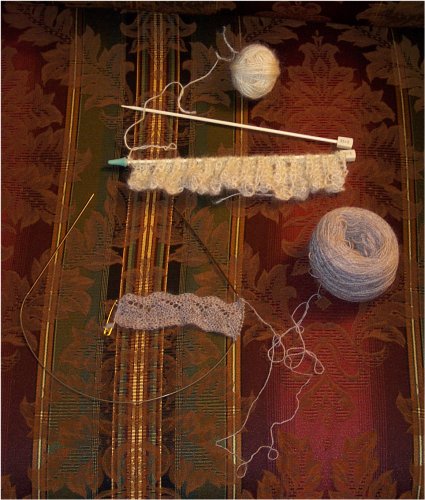
I started out using what is becoming one of my favorite brand of needles, Bryspun, on the Orenburg Shawl pattern. It called for 2mm or smaller. Since I had nothing that small I had to order them, needles that small are usually metal because wood and/or plastic will break easily at that gauge. I had pulled away from using metal needles some years ago and it is becoming evident why with every stitch. Beside being cold, hard and unfriendly, which makes them very uncomfortable to work with, the stitches slip off the tips so readily. Still I am determined to keep working with them in hopes to become more proficient and eventually,.....perhaps....dare I hope to adapt. Somehow I suspect, however, frustration will rear it's ugly head before that happens and convince me to end up modifying patterns to allow a little larger Bryspun.

Labels:

Saturday, February 04, 2006

Creating through the Pain

Some of us, unfortunately, find that creating art can be quite painful. I am one of those who do. I suffer with arthritis and fibromyalgia and I wake up with my hands, among other parts of my body, so stiff and painful that on occasion my husband will gently massage them untill I am able to open and close a fist on my own. The act of picking up a coffee mug can cause the pain in my wrists to shoot all the way up my arm. These complaints can make many fibre activities miserable, especially knitting. If it were not for the enjoyment and relaxation fibre art affords me I am not sure if I could continue.

There are a few things I have found to be helpful in reducing the pain. The first, of course, in the case of knitting, is choosing the correct needles. Warm natural materials like wood, casein and not so natural, plastic, are easier to hold in painful hands. I love my Britanny needles but recently I found the joys of Balene and Bryspun. They, the latter two brands, are not only warm but light in weight and they have the tapered tips that make it easier to insert into a stitch, especially the tighter ones like 'k2tog " or "sl1, k2tog/p2tog, psso". There is another natural brand that has become popular among knitters with arthritic hands and that is the "Ivore" from New Zealand. Again they are warm, light weight and have tapered points.

Then there is, when choosing the right tool, the style, circular, flex or straight. Obviously the longer the needle the more awkward it can be as your work begins to progress and more weight begins to tax any hand or wrist. Imagine when making a shawl or sweater, as the rows accumulate there is more weight placed on the wrists and hands trying to support long singlepoint needles. Circular needles will allow the work to drape and even rest onto your lap so your wrists are supporting the whole project. The same goes for flex needles. The needle itself is small, about 6 inches or so then a plastic cord is attached, not unlike the circulars but instead of connecting the two needles there is a ball on the end of the cord that prevents your work from slipping off. You are still working with two needles but since most of the needle is flexible the work, once again, is allowed to wrest in your lap.

Another precaution you can take to help alleviate pain is frequent breaks to offer your hands rest. I am sure there are some exercises aimed, specifically at painful hands, but what I usually do is to gently contract and flex the fingers making a fist and massaging them, much like my husband does for me on those occasions that I can't seem to manage myself. Warm water is helpful. Just like hot baths will soothe aches and pains in the body the warm moist heat is also helpful in alleviating painful hands. When taking a bath is not feasable allowing warm water to run over your hands can be of some relief.

Labels: